

Lego’s Biggest Set Ever Takes An Unexpected Turn And It’s A Win For Tradition

The following is an edited transcript from The Michael Knowles Show.

* * *

Lego has just announced its largest Lego set ever.

And in our culture, what would you expect that Lego set to be? The pride progress flag? What would you expect it to be — some big lib thing? Maybe even the “Kamala Sitting Under a Coconut Tree” set?

Do you know what it is? It’s a Catholic church.

The largest Lego set ever — some 12,060 bricks priced around $600 — is The Sagrada Familia Basilica in Barcelona, Spain.

This is good news for the culture. We’re not done yet.

The hottest toy that’s coming out this year is of a Catholic church that has been under construction for — what — 140 years now? They started building this thing in March of 1882. It’s not even completed yet. It’s expected to be completed in 2034.

DailyWire+

This is such good news, in the abstract, that I’m willing to overlook the fact that this church is one of the ugliest buildings ever constructed. It is so bad.

I had the privilege of visiting Spain once and got to see The Sagrada Familia Basilica in Barcelona — and it’s pretty ugly. It looks like a melted anthill or some kind of weird distorted honeycomb.

It’s supposed to be kind of like a neo-Gothic church, like all those great Gothic churches of Europe. But it’s weird because it’s modern. Construction started in the late 19th century, and then continued for a long time — these cathedrals can take centuries — and as other people took over, it somehow got even worse.
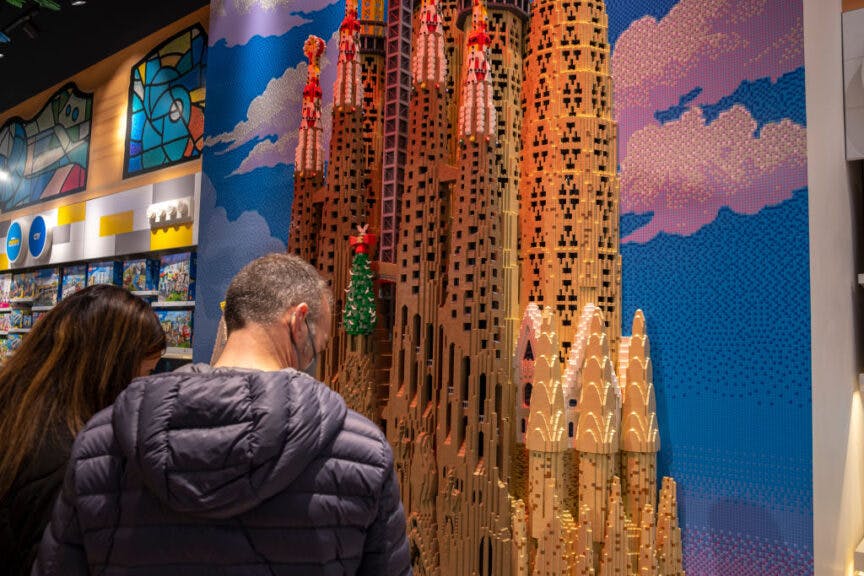
BARCELONA, CATALONIA, SPAIN - 2021/11/20: A lego reproduction of the temple of the Sagrada Família by Antoni Gaudí is seen inside the new store.The Danish construction toy company LEGO has opened a new store on Passeig de Gràcia in Barcelona inspired by the work of the modernist architect Antoni Gaudi. The 800 m2 makes it the brand's third largest store after New York and China. (Photo by Paco Freire/SOPA Images/LightRocket via Getty Images)

Paco Freire/SOPA Images/LightRocket via Getty Images

Now, when you go inside, however, it’s quite stunning. It’s still a little too weird for me to say it’s beautiful, but it is stunning — the way the glass reflects the light. Really stunning.

But it’s just ugly to look at. It’s not as ugly as sin, but it’s ugly.

And yet — we’ll take the “W”. We’ll take the win.

I am confident I will be pilloried from all sides for this — the people who say I’m a Philistine for not appreciating the modern basilica, the people who say I’m too religious not to be focused on a toy church — I don’t care. I’m going to take the win.

But let’s not lie to ourselves. Let’s use our our taste, our real intelligence — not artificial intelligence — and say it’s not ugly.

Listen, Lego could have done the Cathedral of Chartres.

They could have done Notre-Dame de Paris.

They could have —

But no matter. I’ll take the win.

Peak California: USC Backs Out Of Gov Debate Over Lack Of Diversity

The University of Southern California canceled a high-profile gubernatorial primary debate just hours before it was set to take place following backlash over the event’s lack of racial diversity among invited candidates. The debate, scheduled for March 24 and hosted by USC’s Dornsife Center for the Political Future, was scrapped after criticism that the selection criteria excluded several candidates of color.

The original lineup featured six candidates: Republicans Steve Hilton and Chad Bianco, and Democrats Tom Steyer, Katie Porter, Eric Swalwell, and Matt Mahan. Absent were several established Democratic candidates of color, including former Los Angeles Mayor Antonio Villaraigosa, former Health and Human Services Secretary Xavier Becerra, former State Controller Betty Yee, and State Superintendent Tony Thurmond.

USC had initially defended its selection process, saying invitations were based on a “data-driven” formula developed by a university professor that weighed polling and fundraising. But critics argued the methodology produced a skewed outcome in a crowded race with no clear frontrunner.

The controversy escalated after California legislative leaders demanded the university expand the debate field. “Every excluded leading candidate—Xavier Becerra, Betty Yee, Tony Thurmond, and Antonio Villaraigosa—is a person of color,” lawmakers wrote in a letter to USC President Beong-Soo Kim. “When a methodology produces this outcome … the burden falls on USC to explain itself, not on everyone else to accept it.” The letter went further, calling on voters to boycott the event if the university refused to revise its criteria.

“If USC does not do the right thing, we call on California voters to boycott this debate,” the lawmakers wrote. “If the university will not give voters a fair shot at evaluating everyone running for governor, voters should find other ways to learn about the candidates.”

Despite standing by the formula’s academic backing, USC ultimately reversed course late Monday, announcing the debate would be canceled after organizers failed to reach an agreement on expanding the stage. “We recognize that concerns about the selection criteria … have created a significant distraction from the issues that matter to voters,” the university said in a statement.

The decision comes amid an unusually crowded and fluid race to replace Gov. Gavin Newsom, with no candidate polling above 20% in the last month and multiple contenders clustered within single digits of one another. That lack of a clear frontrunner has heightened the stakes around debate access, with candidates arguing that exclusion from major forums could significantly impact voter awareness in a low-information primary.

California’s primary system adds another layer of complexity. Under the state’s “top-two” format, all candidates, regardless of party, appear on the same ballot, and only the two candidates who receive the most votes advance to the general election. That structure has raised concerns among Democrats that a fragmented field could allow two Republicans to advance if the vote is split.

San Jose Mayor Matt Mahan, whose inclusion drew particular scrutiny due to his late entry into the race and strong fundraising from wealthy donors, said canceling the debate was the wrong approach. “The answer isn’t to cancel debates, it’s to hear all voices,” he wrote on X.

Former Los Angeles Mayor Antonio Villaraigosa, one of the excluded candidates, praised the decision. “USC made the right call, even if it came late and under pressure,” he wrote in a post after the decision.

The tension surrounding how institutions balance data-driven decision-making with political and social considerations is not unfamiliar in California, a state where diversity is treated as a central benchmark of legitimacy. In this case, sadly, a formula designed to measure candidate viability ended up triggering the very kind of equity concerns it was meant to avoid, ultimately leaving voters with no debate at all.

The California gubernatorial primary election will be held on June 2, 2026.

About Us

Virtus (virtue, valor, excellence, courage, character, and worth)

Vincit (conquers, triumphs, and wins)